

Company Introduction
Wuhu Shipyard Co., Ltd. (hereinafter referred to as Wuhu Shipyard) is a modern shipbuilding enterprise in China. The company owns Wuhu Shipyard headquarters, Weihai Shipbuilding Base, Anhui Haizhi Equipment Research Institute, Shanghai Haizhi Zhiyuan Technology Co., Ltd., and Wuhu Fujiheng Machinery Co., Ltd.
Wuhu Shipyard Weihai Base, as Anhui's first inland shipbuilding coastal project, integrates green, intelligent, and sustainable development concepts, focusing on the research and manufacturing of marine engineering equipment. The base covers shipbuilding, design, and repair, as well as marine engineering equipment and offshore wind power equipment development. Its core facilities include a 100,000-ton dock and two 50,000-ton slipways, mainly producing high-value vessels such as 3,000 to 9,000 car carriers and 50,000 DWT MR product oil tankers. The entire project is estimated to invest 2 billion RMB, occupying about 680 mu of land, with a planned capacity of 800,000 DWT and an annual output value of 5 billion RMB.
Project Background
With a century-old tradition, Wuhu Shipyard is committed to revitalizing the national shipbuilding industry by implementing a “toward rivers, toward the Yangtze, toward the sea” product strategy. It expands externally and constructs a “1+2+N” development pattern, aiming to become an innovation leader in the shipbuilding industry, a revitalizer of China's traditional shipbuilding industry, and a practitioner of high-quality development. The Weihai base, jointly built by HG Tech and Wuhu Shipyard, is equipped with cutting-edge dynamic vision technology and thin plate laser composite welding technology, enabling highly coordinated human-machine collaboration, reducing labor by about 40%, with an intelligent centralized control system autonomously allocating internal resources. The workshop automation rate reaches 80%. Integrating advanced technology with intelligent management and physical safety protection measures, it enhances safety and efficiency, making it a "super factory" in the shipbuilding industry.
Construction Scope
The automation production line implementation at Weihai Base’s cutting and blanking workshop includes turnkey delivery covering the entire line’s design, manufacturing, packaging, transportation, installation, commissioning, and providing technical support as well as training for operators and maintenance personnel. It ensures all equipment is new, advanced, reliable, complete, and reasonably arranged.
1) Production Line Layout
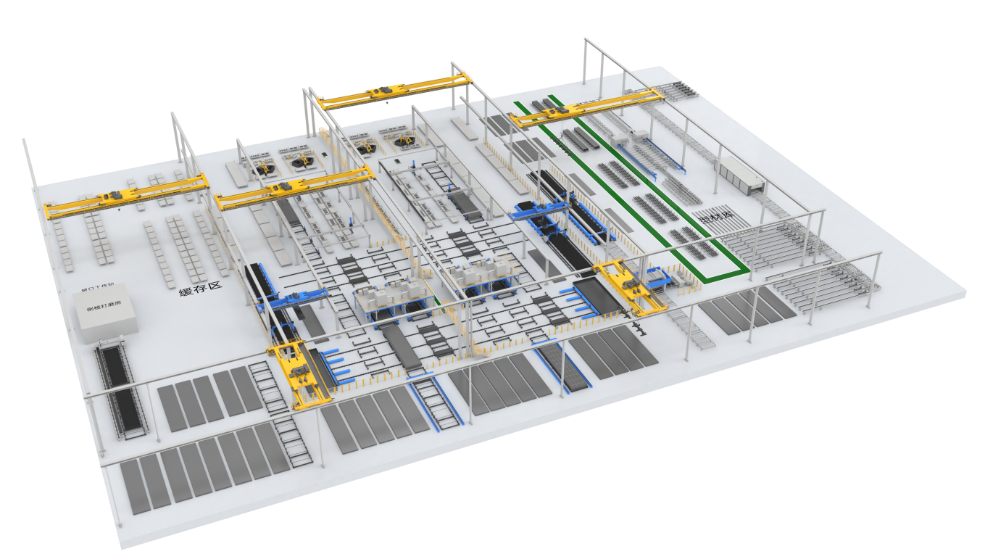
Overall Layout Plan
2) Process Flow
Component Cutting Line Process Flow

(1) Manual crane lifts steel plates to the marking and scribing station, starting the component cutting line;
(2) Marking machine sprays codes and scribes lines on the steel plates on the roller bed;
(3) After coding, the conveyor rollers advance, transporting the steel plate pallets onto the transfer trolley;
(4) Transfer trolley moves steel plate pallets to laser cutting or buffer stations; the laser cutter performs automatic edge detection and cutting, then returns pallets to the transfer trolley;
(5) Transfer trolley moves cut steel plate pallets to small or large parts sorting areas (no small parts at this stage);
(6) Transfer trolley transports cut steel plates to the small parts sorting area; manual sorting station separates mini parts; truss automatically sorts small parts from steel plates and stacks them onto pallets;
(7) The first sorting station can be lifted to facilitate steel plate transfer to the next sorting station. Empty pallets from the first sorting station return to the transfer trolley via hydraulic lift;
(8) AGV delivers stacked small parts pallets to the robot chamfering and beveling workstation. The workstation automatically loads/unloads parts for chamfering and beveling, placing processed parts back onto pallets. AGV then delivers completed pallets to the collection area;
(9) Transfer trolley picks up small parts sorted steel plate pallets and sends them to the large parts sorting area;
(10) Intelligent crane sorts large parts from steel plates, places parts onto conveyor for large part chamfering and beveling, then stacks parts on large pallets using the intelligent crane;
(11) Transfer trolley picks up large parts sorted steel plate pallets and disposes scrap at the scrap collection station;
(12) Disposed steel plate pallets are transported back to the line start point.
Deck Cutting Line Process Flow

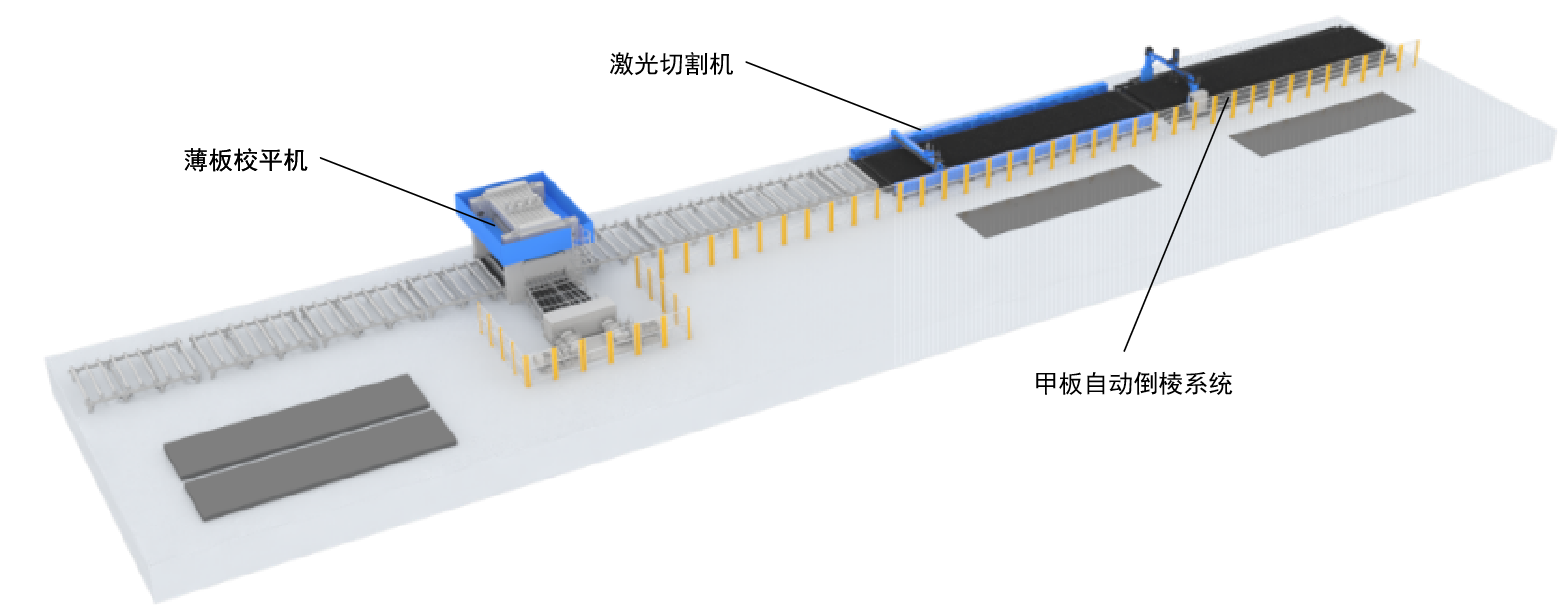
(1) Manually hoist steel plates to line start, followed by automatic leveling machine;
(2) After leveling, laser cutting machine sprays code and cuts steel plates;
(3) Manual sorting of scrap (if any);
(4) Deck chamfering workstation performs chamfering on workpieces;
(5) Completed steel plates manually hoisted to line buffer points.
Profile Cutting Line Process Flow
(1) Manually hoist profiles to line start – loading platform automatically separates profiles online;
(2) Profiles split into two lines at feeding station, marked and scribed by automated marking and scribing system;
(3) Profiles enter plasma cutting room for automatic cutting;
(4) After cutting, profiles go to unloading platform for automatic sorting (semi-automatic sorting, grinding, flipping, buffering, etc.);
(5) Profiles manually consolidated and organized onto profile pallets.
Benefits and Value
· Labor Reduction
By introducing transfer trolleys, conveyor rollers, AGVs, and other logistics equipment, traditional hoisting operations are replaced, reducing manpower needs. Additionally, marking and scribing machines and laser cutters feature automatic edge detection, enabling operation without human involvement except for consumables replacement. This labor reduction improves production efficiency and lowers labor intensity and costs.
· Equipment Intelligence
Marking and scribing machines support automatic edge detection, automatic coding, and QR code verification; cutters support automatic edge detection and cutting. These advanced functions in Weihai base’s cutting and blanking workshop improve production efficiency and quality.
· Equipment Integration
The small parts chamfering and beveling workstation integrates both functions, making the equipment more compact and efficient, reducing transfer motions and repeated positioning, thereby maintaining production rhythm and improving efficiency.
· Traceability
Steel plates and parts are labeled with QR codes and visible codes, enabling traceability of process information, product data, and processing status. This system allows comprehensive management and control of materials, helping the workshop track quality, promptly address issues, and improve product consistency and reliability.
· Logistics Efficiency
With powerful automated sorting by truss robots, all small parts are accurately sorted into corresponding bins quickly, reducing labor and time costs. Small parts transportation uses AGVs, which autonomously navigate preset routes to deliver bins precisely and rapidly, outperforming manual handling.