

Company Introduction
Jiangnan Shipyard originated from the Jiangnan Manufacturing Bureau, founded in 1865 during the Qing Dynasty (the fourth year of the Tongzhi reign). In the early 1950s, it was renamed Jiangnan Shipyard, and in 1998, it was restructured into a corporate enterprise. In June 2008, due to the needs of the World Expo construction and its own development, Jiangnan Shipyard was entirely relocated from the banks of the Huangpu River to Changxing Island.
As "China's First Shipyard," Jiangnan Shipyard has witnessed over a century and a half of profound changes. It has endured through time, remaining prosperous and resilient, having created over a hundred national firsts. It is hailed as the birthplace of national industry and military industry, the cradle of industrial workers, a spark for early Communist revolution, and a pioneer of reform and opening-up in China.
Project Background
To promote intelligent transformation and upgrading, Jiangnan Shipyard is shifting from tactical to strategic thinking, and from "exquisite" to "classic" manufacturing. It aims to foster technological innovation and build a tech-driven manufacturing enterprise, while advancing digital transformation—from a single digital model to a fully digital enterprise. The plan is to construct a cutting workshop in Jiangnan Shipyard's manufacturing department and upgrade a high-precision integrated cutting line for assembly components. This line includes high-precision laser cutting equipment for plates, a loop conveyor system, and other equipment, forming a fully integrated high-precision cutting line across the workshop to enhance upstream processing capabilities.
Construction Content
The "High-Precision Integrated Cutting Line" project undertaken by HGTECH covers a workshop area of 2,838 m². After preprocessing, raw materials are transported from the east side via conveyor to the cutting shop, and the cut parts are sent from the west side logistics aisle to the assembly welding workshop. The production line mainly includes: 2 sets of 30KW laser cutting machines, 2 manual overhead cranes, 2 RGV transverse transfer carts, 2 automatic sorting stations, 1 reserved automatic beveling station, and 1 manual beveling station—suitable for cutting and sorting parts with thicknesses of 4–30 mm, lengths of 0.15–16 m, and widths ≤3.6 m. With the support of the conveyor line and pallet-based steel logistics system, when six pallets operate simultaneously, the maximum cutting capacity reaches 2,028 meters in a single 8-hour shift, producing 600 small sub-assembly parts. The line balance rate is 70%. After project completion, all key metrics are expected to improve by more than 30% compared to the pre-upgrade baseline.
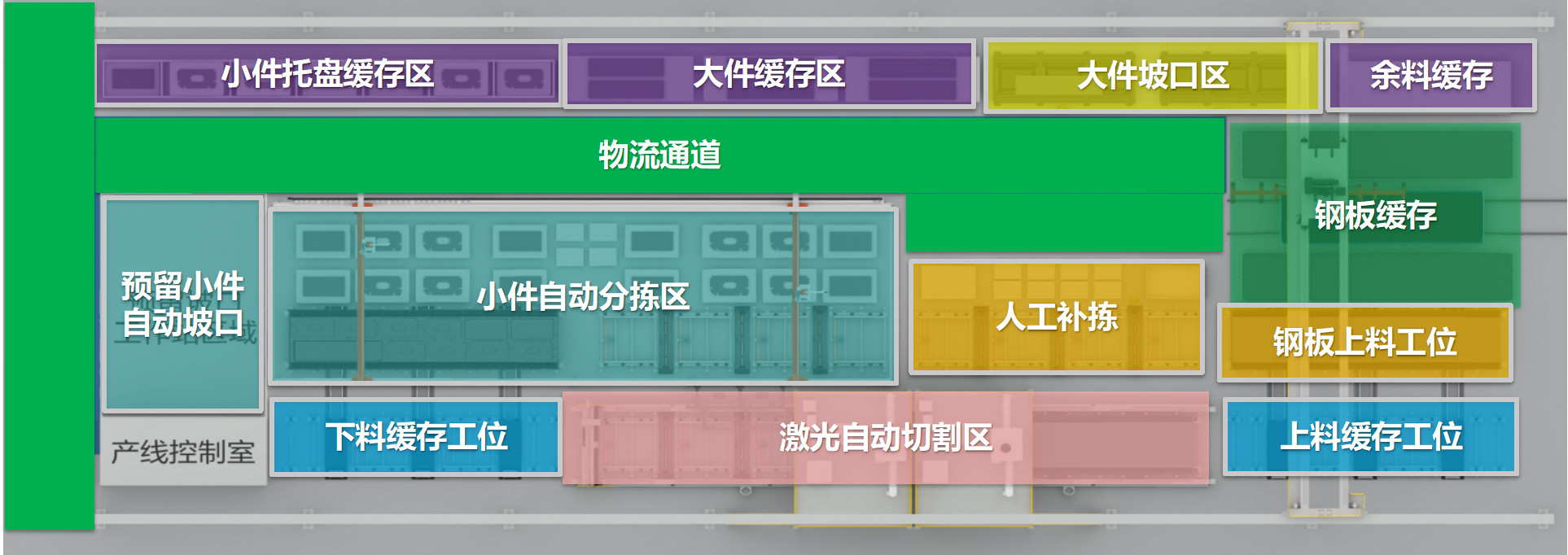
Figure: Layout of High-Precision Integrated Cutting Line
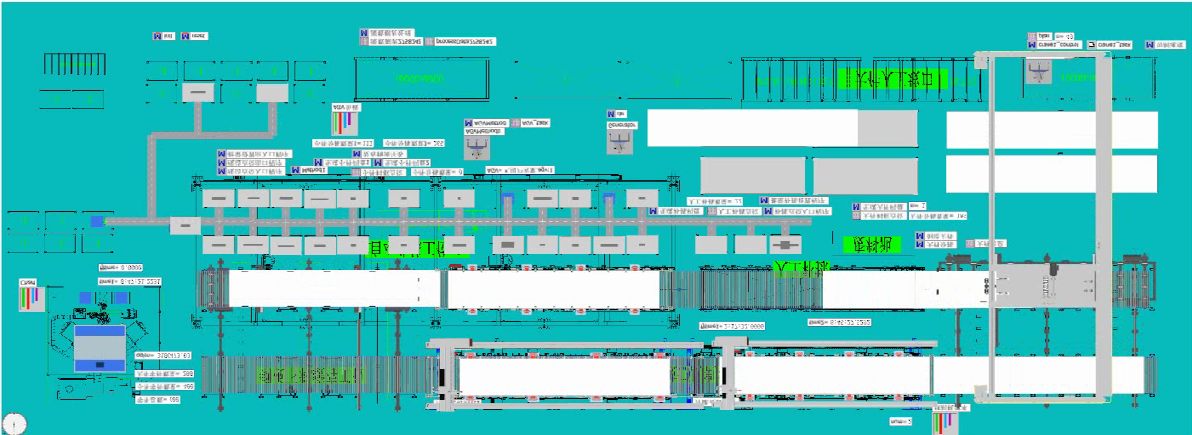
Figure: Simulation of High-Precision Integrated Cutting Line