

Company Profile
Hubei Changjiang Electric Co., Ltd. is a global provider of integrated smart energy solutions, specializing in smart energy systems, intelligent power transmission and distribution equipment, fire protection projects, and EPC services. With a production capacity exceeding 10 billion RMB, the company operates 16 subsidiaries and maintains a business and service network across all provinces of China and over 20 countries and regions worldwide.
Changjiang Electric boasts strong innovation and R&D capabilities, supported by a high-level team of professors, PhDs, and postgraduates. The company has achieved a number of breakthrough innovations, particularly in the smart grid sector, where it holds numerous national patents and software copyrights. Building on independent research, the company has also established solid technical partnerships with global industry leaders such as Siemens, ABB, and Schneider Electric. With a strong focus on quality management and brand development, Changjiang Electric has made significant investments to establish Central China’s first smart grid industrial park and has introduced world-class intelligent manufacturing centers. The company is a pioneer in industry certifications, having passed ISO 9001:2008 (Quality Management), ISO 14001:2004 (Environmental Management), OHSAS 18001:2011 (Occupational Health and Safety), as well as China Compulsory Certification (3C), and multiple licenses for power facility installation, repair, testing, and general contracting for power and transmission projects.
Project Objectives
The Flexible Sheet Metal Line Project at Changjiang Electric includes an intelligent warehouse and an MES system. The project objectives are as follows:
1) Enable automatic identification, storage, and retrieval of raw materials and semi-finished products through the intelligent warehouse.
2) Achieve seamless automation between the warehouse and sheet metal processing using RGVs, handling robots, and gantry manipulators, enabling efficient and flexible production.
3) Leverage the MES system for equipment interconnection, production scheduling, control, and data collection, enabling digitalized stamping and bending, and real-time, transparent production management.
4) Integrate information and logistics flows to optimize production planning, enhance logistics efficiency, and improve overall competitiveness.
Scope of Construction
The physical scope and content of the Hubei Changjiang Electric Flexible Sheet Metal Line Project are as follows (areas marked in blue):
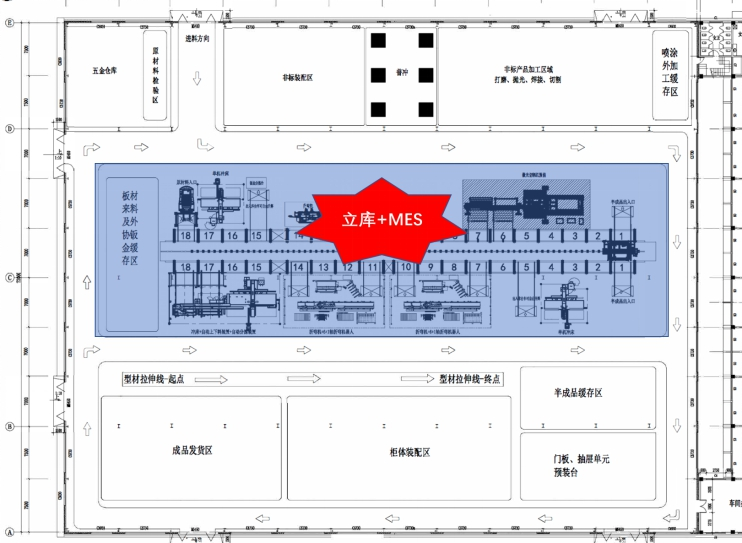
Pic:Scope of Construction
1)Intelligent Warehouse
Serial No. |
Item |
Parameter |
1 |
Number of Aisles |
1 |
2 |
Number of Stackers |
1 |
3 |
Number of Storage Locations |
2 aisles × 18 bays × 8 levels – 23 = 265 storage locations |
4 |
Storage Item Dimensions |
1600×3100×280mm 49 slots 1600×3100×700mm 216 slots |
5 |
Storage Item Weight |
3500kg |
Table:Storage Area Planning
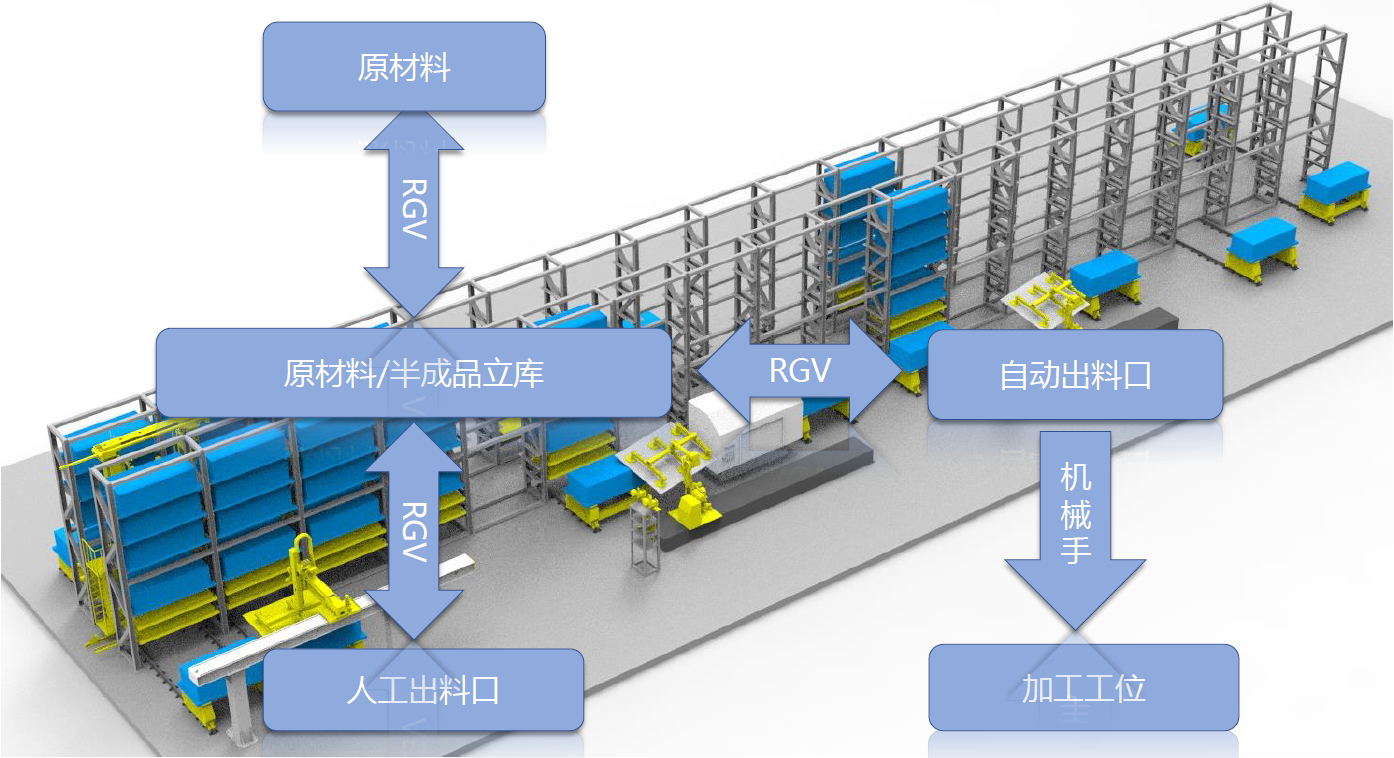
Pic :Overall Layout of the Automated Warehouse
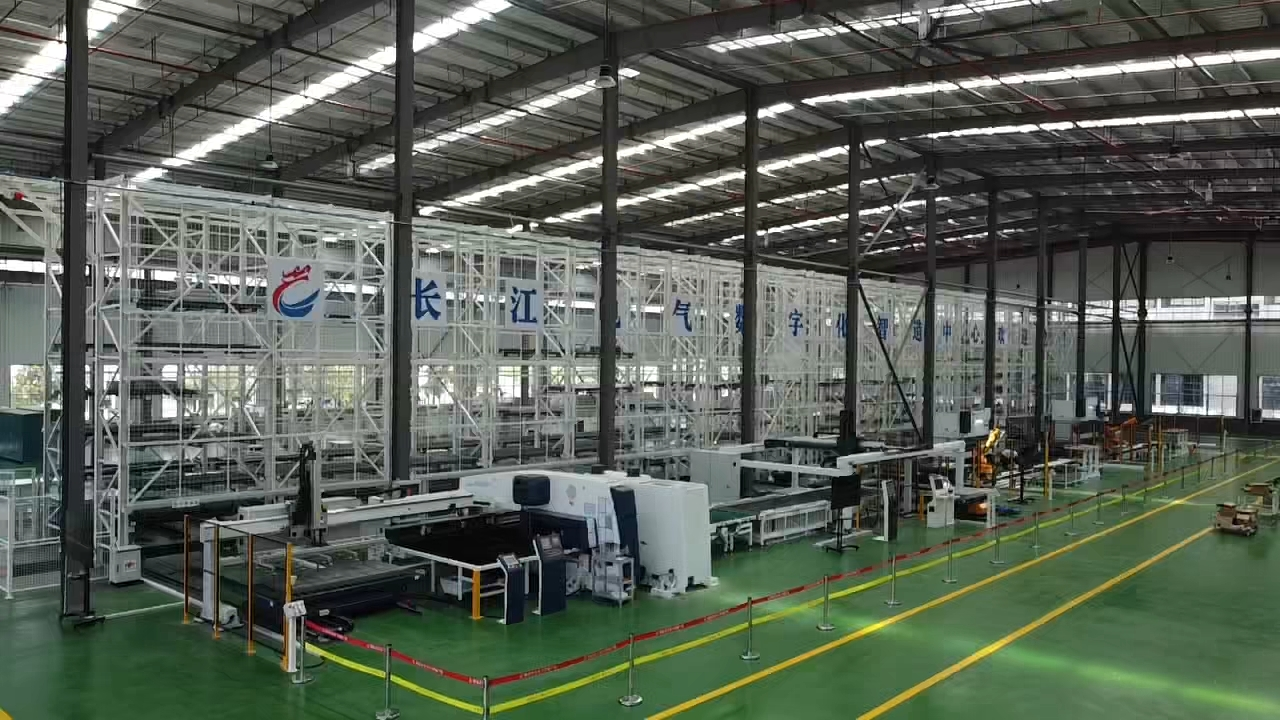
Pic :Changjiang Electric Digital Workshop On-site Photo
The automated warehouse WMS (Warehouse Management System) consists of core application subsystems including system management, master data management, inbound management, outbound management, inventory management, system queries, and external system interfaces. The WCS (Warehouse Control System) connects upstream to the WMS via Ethernet to receive handling tasks and report task execution status. Downstream, the WCS communicates with the main PLC of the electrical control system through shared memory, decomposing the received tasks and assigning them to the underlying equipment to execute the handling operations.
2)Sheet metal workshop MES system
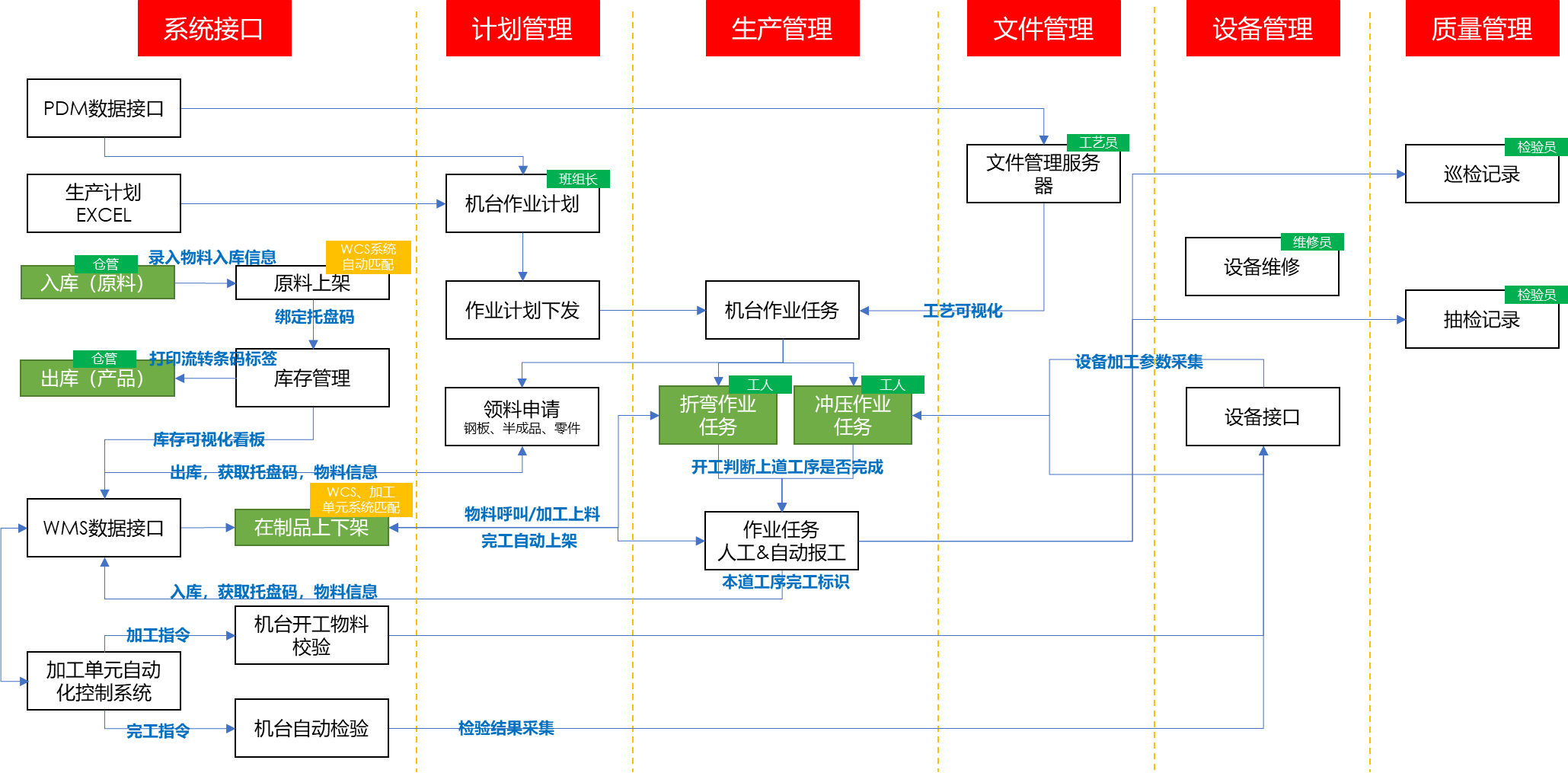
Scope of Changjiang Electric MES System
Functions:
① Production Planning
Ø The system supports manual input, Excel import, and ERP work order interface (reserved).
Ø It can schedule equipment production plans based on equipment capacity and task volume.
Ø It allows users to view production capacity by work order and equipment.
② Production Execution
Ø Supports reporting from both manual and automated production areas.
Ø Supports barcode tracking throughout the production process.
Ø Links equipment parameters to barcodes for tracking and query.
Ø Manages outsourced processing with work orders for release, receipt, and inspection.
③ Process Visualization
Ø Supports storing and viewing of process documents, including inspection and drawing files.
Ø Includes SOP (Standard Operating Procedure) management linked to different processes.
Ø Operators can access process documents, such as viewing electronic drawings for punching.
④ Traceability Management
Ø Supports barcode tracking throughout processing.
⑤ Quality Management
Ø Supports inspection modes such as patrol and sampling checks.
Ø Enables reporting of inspection results via PDA.
Ø Supports maintenance of common defect causes.
Ø Provides inspection result statistics.
⑥ Equipment Management
Ø Manages equipment ledgers.
Ø Supports repair, maintenance, inspection, and fault reporting.
Ø Enables equipment connectivity and data collection.
Ø Collects energy consumption data for analysis.
Ø Collects machine runtime and output data for efficiency analysis.
⑦ Report Management
Ø Provides production reports (planned vs. actual output).
Ø Generates material usage reports (raw material usage, yield, utilization rate).
Ø Tracks output and completion time for each process step.
⑧ Digital Display Boards
Ø Line board: displays real-time line status, equipment status, daily output, operator work time.
Ø Workshop board: shows actual workshop performance, including plan quantity, output, defects, and estimated completion time.
⑨ System Integration
Ø Integration with WMS is required.
Ø Integration with the automated production line system is required.
3) System Integration
The project involves multiple hardware and software systems, including MES, WMS, and automated line control systems. The MES must ensure seamless data exchange and process coordination with the smart warehouse and automated production lines.
Business Description |
Interface Name |
Description |
Direction |
Production Preparation |
Inventory Quantity Interface |
Get material and semi-finished product inventory information |
WMS -> MES |
In-Process Task Data Interface |
Obtain in-process task information from automated production line |
Automated Line System -> MES |
|
Processing File Interface |
Push NC file and other data |
MES -> Automated Line System |
|
Production Start |
Material Delivery Data Interface |
Push material delivery list |
MES -> WMS |
Production Reporting |
Processing Completion Quantity Interface |
Push processing completion quantity (Note: completion quantity is calculated based on NC file execution count from the equipment and reported defective quantity) |
Automated Line System -> MES |
Semi-Finished Product Warehousing |
Processing Completion Inbound Quantity Interface |
Push processing completion quantity |
MES -> WMS |
Inventory Update |
Processing Inbound Completion Quantity Interface |
Push material and semi-finished product inventory quantity information |
WMS -> MES |
Table:System Data Interface
① Equipment Connectivity
By integrating underlying production line equipment, a data collection platform is established to gather production and operational data from each device through automation and information technologies. This data is centrally stored and monitored, forming a comprehensive information platform that provides raw data sources for upper-level systems such as MES, energy management systems, and industrial big data platforms.
Equipment connectivity solution: Devices on the production line are connected to the workshop’s industrial Ethernet via Ethernet modules.
② Equipment Data Collection
Data collection requirements for standalone equipment (punch presses and bending machines):
Ø Support data collection via RCI interfaces for product model, station cycle time, production quantity, and equipment utilization rate;
Ø Support data collection via RCI interfaces for equipment status, processing time, processing parameters, and alert information;
Ø Support offline NC programming; the NC file can be placed in a shared folder via LAN, accessed directly from the equipment control panel, and confirmed by the operator before starting production;
Ø Support energy management data collection, including water, electricity, and gas;
Ø Support equipment efficiency monitoring through the Monitor module.
Data collection requirements for automated production lines (punch-shear composite line and bending automation line):
Ø Support data collection via OPC UA and other standard IIoT protocols for product model, station cycle time, production quantity, and equipment utilization rate;
Ø Support data collection via OPC UA and other standard IIoT protocols for equipment status, processing time, processing parameters, and alert information;
Support offline NC programming; the NC file can be placed in a shared folder via LAN, accessed directly from the equipment control panel, and confirmed by the operator before starting production;
Support energy management data collection, including water, electricity, and gas;
Support equipment efficiency monitoring.
Value and Benefits
Through the integration of informatization, automation, and intelligence, a benchmark project for a digital sheet metal processing workshop has been established. The construction of the intelligent warehouse enables automated loading and unloading on production lines, automated scheduling between the AS/RS and production equipment, improves workplace safety, reduces the risk of injury, eases the workload of staff, and significantly boosts productivity. The space-saving storage method also provides more usable area for production.
The implementation of the MES system achieves refined management and a transparent factory. By connecting MES with production equipment, the system monitors equipment status and production operations in real time. An intelligent monitoring platform is built to deeply integrate and visualize data related to workforce, workshop equipment, materials, production methods, process flows, and the overall shop floor environment, providing strong data support for factory management and decision-making.