

Wuchang Shipbuilding Industry Group Co., Ltd., a subsidiary of China Shipbuilding Industry Corporation (CSIC), was founded in 1934 and was one of the 156 key construction projects during China’s First Five-Year Plan. After years of development, Wuchang Shipbuilding has more than 14,000 employees, occupies an area of 8.4 million square meters, and owns over 40 billion yuan in assets. It has established three major production bases: Wuhan Wuchang, Qingdao Haixi Bay, and Wuhan Shuangliu, and developed nine coordinated product segments including military products, military trade, marine engineering and large ships, small and medium-sized ships, bridge structures, construction steel structures, energy equipment, special complete sets of equipment, material trade, and logistics services.
Wuchang Shipbuilding has established internationally recognized quality management systems, occupational health and safety systems, and environmental management systems, as well as construction systems compliant with major international classification societies. It holds more than 200 qualifications, including China's top-grade steel structure manufacturing qualification, special equipment manufacturing licenses, and national industrial product production licenses, making it one of the most comprehensively qualified enterprises in China's shipbuilding industry.
As a leading manufacturer in China's bridge steel structure industry, Wuchang Shipbuilding has participated in the construction of 168 large bridge projects across the country. From the Hangzhou Bay Bridge in the east to the Liuwu Bridge in Lhasa in the west, from Nanning Bridge in the south to the Qingdao Bay Bridge in the north, and it has also entered markets in Southeast Asia, Chile, and the United States. Successfully undertaking the Hong Kong-Zhuhai-Macao Bridge project has further cemented its leadership in the bridge market. Recently, it has also obtained EU CE and US AISC certifications, paving the way for expansion into the European and American markets.
To respond to the national "Made in China 2025" initiative and meet the intelligent manufacturing demands of the bridge industry, Wuchang Shipbuilding is building a new four-span workshop in the bridge section of the Shuangliu Base, taking the opportunity of relocating its bridge panel unit production. The goal is to establish an intelligent manufacturing workshop for bridge panel units with an annual output of 160,000 tons of steel box girder panels.
The intelligent panel unit workshop equipment is based on the production line process equipment used in the Hong Kong-Zhuhai-Macao Bridge project, with the addition of advanced intelligent processing equipment to enhance the integration of informatization and automation. It also includes the construction of an intelligent steel plate warehouse and pre-treatment line in the existing plant to form an intelligent manufacturing workshop from steel processing to panel unit production.
Wuchang Shipbuilding has won the bid for the national Shenzhen-Zhongshan Link project and treats it as a key target project. This project requires the application of BIM technology throughout the construction process, achieving full digitalization, automation, and informatization. The smart production workshop will be implemented according to the intelligent requirements of the Shenzhen-Zhongshan Link.
Wuchang Shipbuilding Smart Manufacturing Information Platform – CSIC-IMS System Construction Project
The project adheres to the concept of "digitization, networking, intelligence, greening, and servitization", with overall planning and scientific design. It introduces mature and advanced bridge manufacturing equipment and accelerates the integration of IT and manufacturing technologies, aiming to create a leading smart manufacturing model in the bridge steel structure industry. The project includes intelligent material cutting and panel unit welding production lines and an integrated information platform under the "Four Lines and One System" framework for the Shenzhen-Zhongshan Link project.
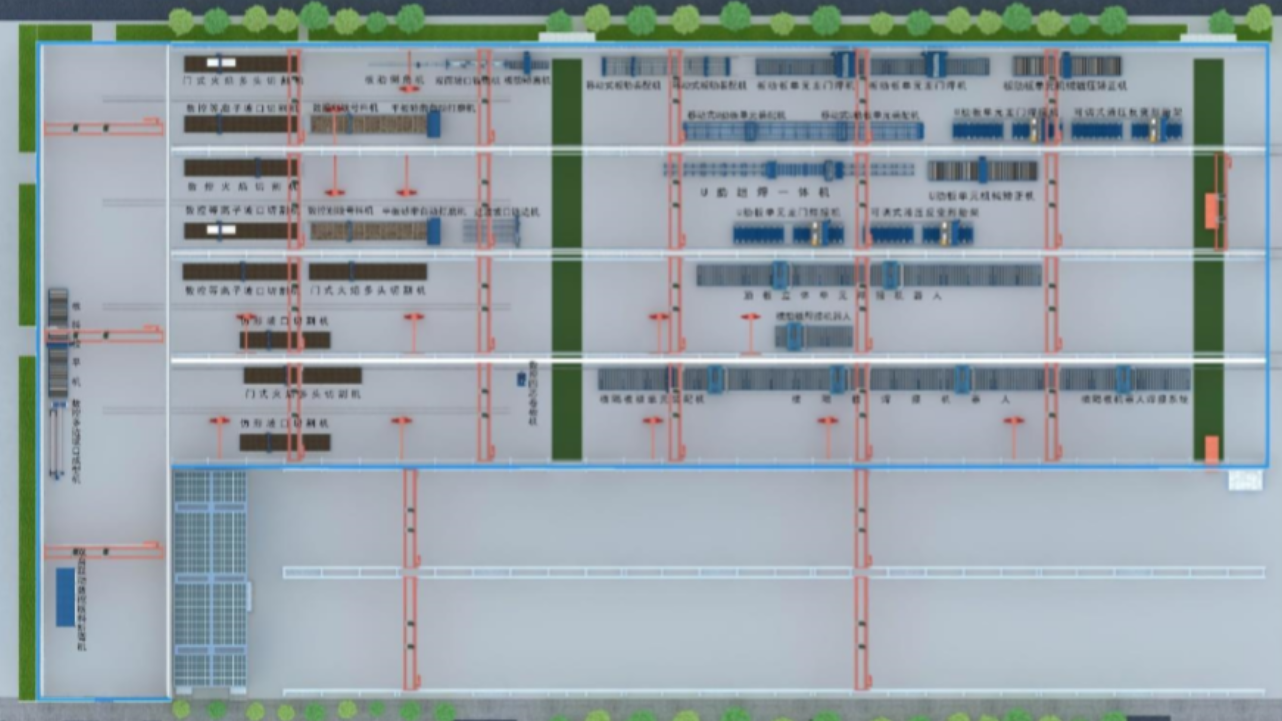
Figure: Digital production line layout of bridge panel unit
The intelligent manufacturing information platform includes four subsystems: ERP for business decision-making, PDM for full digital model management, LES for material optimization and control, and MES for integrated manufacturing management, and interfaces fully with the owner's BIM management platform.
By integrating various business systems on a unified platform, it leverages the advantages of existing and future IT resources, supporting dynamic management models and workflows. The platform uses an ESB-based enterprise application integration framework and an SOA architecture to achieve high-efficiency system integration and business process coordination.
1) Building a standard-based enterprise portal
An SOA-compliant enterprise portal is constructed, integrating existing systems for single sign-on and standardized UI across the platform.
2) Using ESB to integrate various business systems
ESB enables the integration of different systems through a service-oriented architecture (SOA), managing processes and services independently, ensuring secure and efficient integration and communication.
3) Unified data integration and visualization
Data is extracted from each system and visualized through reporting tools to support decision-making and centralize data presentation and analysis.
System architecture is shown below:
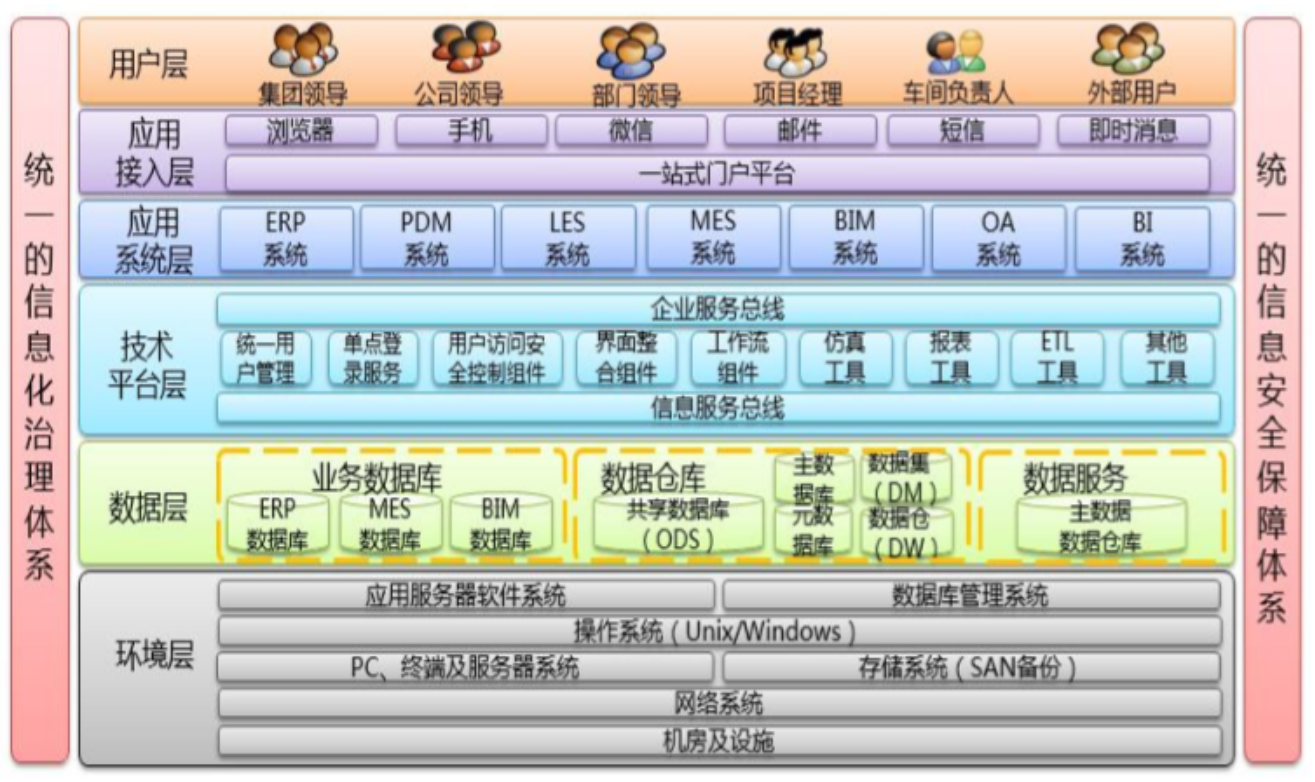
Figure: Overall system architecture
Digital Management Platform
The digital management platform, acting as the brain and nervous system of the digital enterprise, is based on the integrated ERP system, supporting resource management, decision-making, and production planning.
Digital Design
Digital design is the foundation of the digital enterprise. The PDM system manages CAD, CAPP, CATIA, and other digital models, supporting visualized product data, process planning, and project management.
Digital Manufacturing
As the core of the digital enterprise, the MES-based digital manufacturing system manages production processes in a digital, automated, and intelligent manner. It enhances flexibility and reduces quality, cost, and time risks. Functions include scheduling, production control, equipment management, and quality traceability.
Digital Material Management
LES-based digital material management serves as the backbone of the enterprise resource system, integrating planning, nesting, warehousing, and equipment data monitoring to standardize warehouse operations, reduce errors, and improve logistics and cost efficiency.
Project Value and Benefits
Once completed, the intelligent panel unit production line at Shuangliu Base will enhance processing capabilities, reduce manual interventions like beveling and correction, enable real-time weld monitoring, achieve an annual capacity of 160,000 tons, and improve IT-automation integration.
(1) Improve production efficiency
Optimization of steel plate storage reduces manual sorting time, increasing storage efficiency by 50%. MES supports agile scheduling and change management, improving planning efficiency by 10%. Optimized equipment usage improves production rates, e.g., 12,600 ribbed panel units/year, 6,000 bottom plates, etc.
(2) Reduce labor costs
Adding new beveling machines, straightening machines, and welding equipment reduces manual workload and optimizes staffing.
(3) Improve intelligence level
Smart warehouses and networked production equipment allow for integrated data management and visualization. All systems converge into a unified BIM-compatible intelligent workshop.