

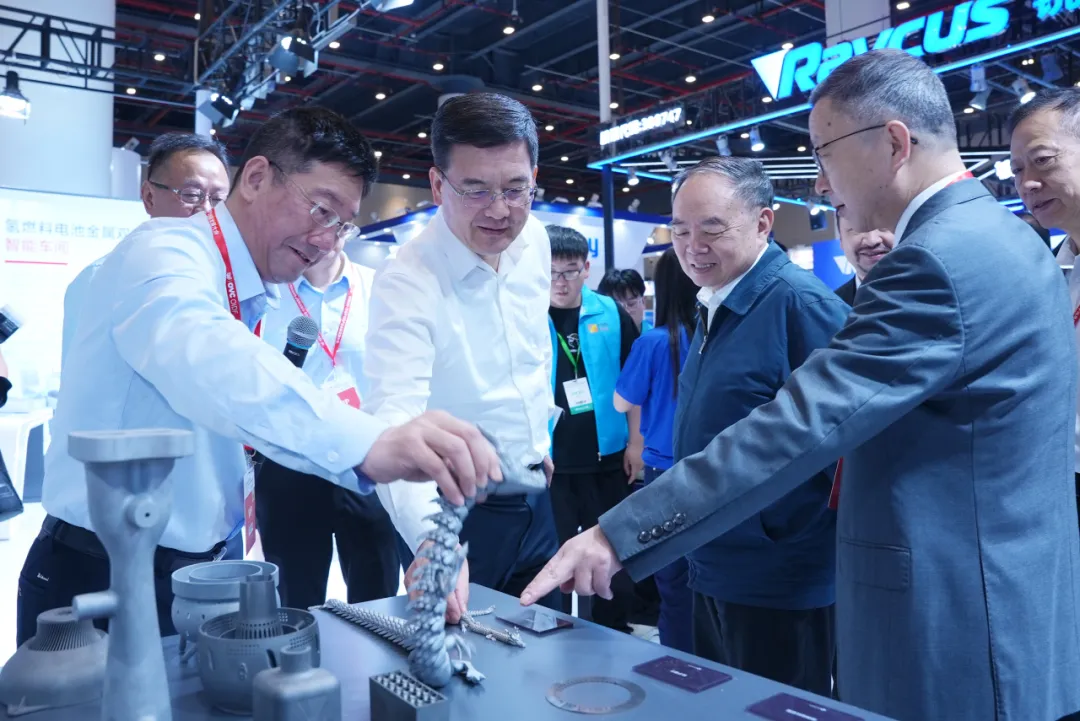
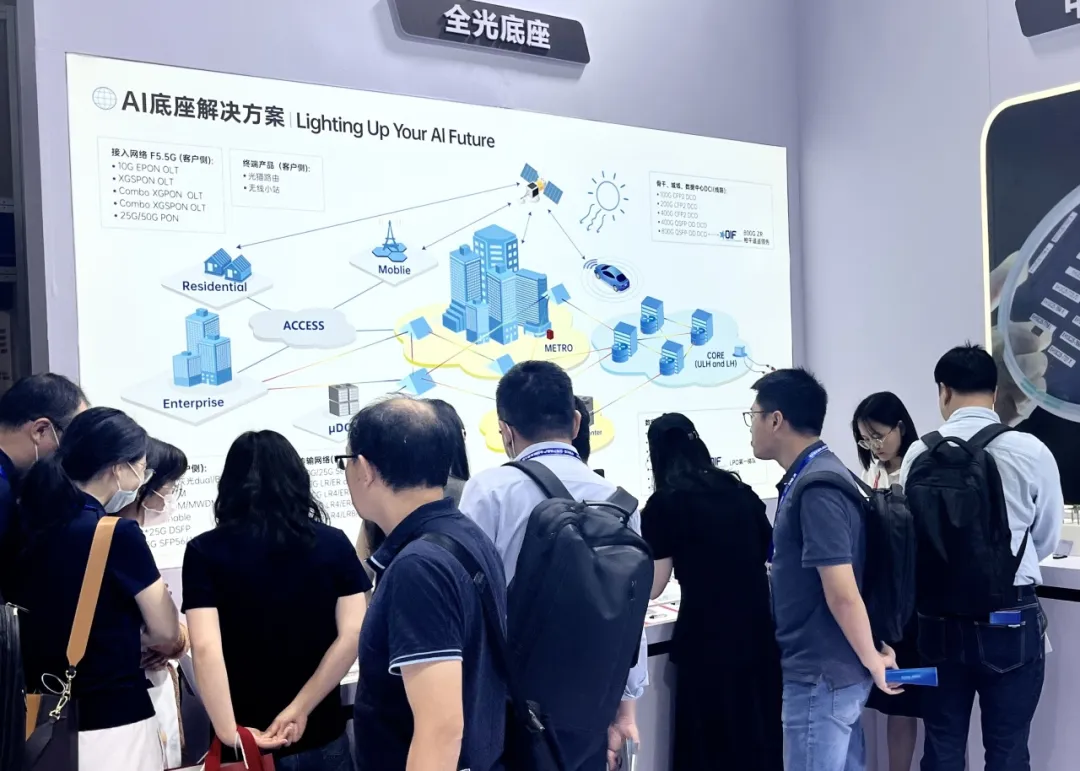
On May 16, the 2024 China Optics Valley Optoelectronic Information Industry Innovation and Development Conference opened at the Optics Valley Science and Technology Convention Center. Huagong Tech showcased its optical communication and laser + intelligent manufacturing solutions at the event. Its core subsidiary, HG Genuine Optoelectronics, presented its “Optical Communication + AI Infrastructure” solutions, including the 1.6T high-speed silicon photonic module. Senior officials such as Sheng Yuechun, Vice Governor of Hubei Province, and Zhou Ji, Academician of the Chinese Academy of Engineering, visited the booth for guidance.
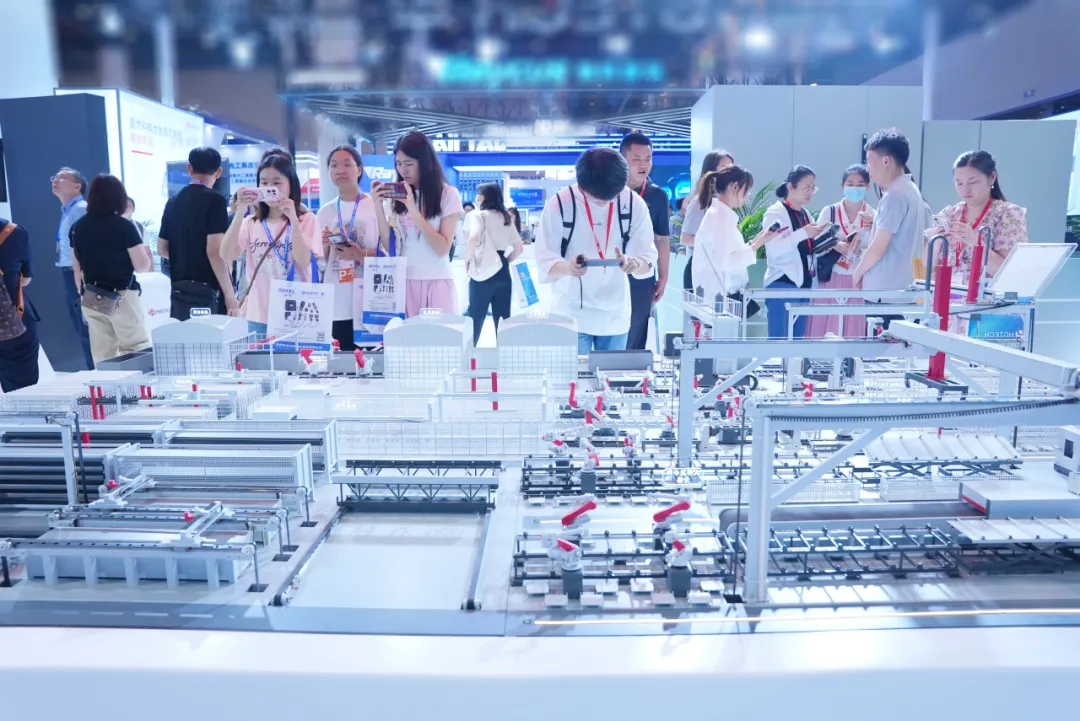
Immersive Experience: Smart Factory Model Brought to the Show
The intelligent factory model for the heavy industry on display was based on the benchmark project Huagong Tech developed for Taiyuan Heavy Industry. The model consists of five core production lines: sheet cutting, profile cutting, welding, painting, and assembly, demonstrating the heavy industry’s production process, line layout, and logistics planning. This model allows visitors to experience the technological innovation and vast potential of intelligent factories in heavy industry in an intuitive and immersive way.
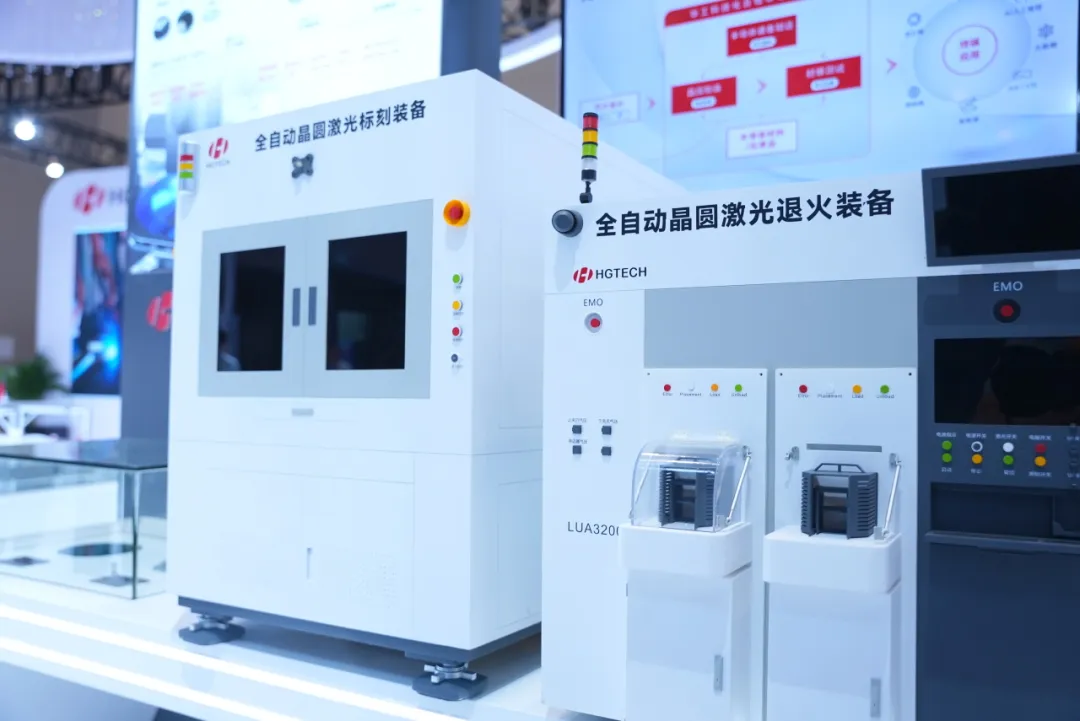
Industry-Academia-Research Collaboration Accelerates Domestic Advancement
Huagong Tech’s self-developed LUA3200 fully automatic wafer laser annealing equipment can anneal transition metals deposited on the back side of heavily doped SiC wafers. It improves annealing uniformity to 95% and boosts efficiency by 30%, while ensuring a more secure and controllable supply chain for core components. The semiconductor team from Huagong Laser closely collaborated with the School of Mechanical Science and Engineering at Huazhong University of Science and Technology to complete unit technology development, equipment design, assembly, and debugging. The localization rate of the equipment exceeds 80%. The system is currently in the debugging phase and is expected to be delivered to a Fab customer for verification and first-batch sale in the second half of the year.
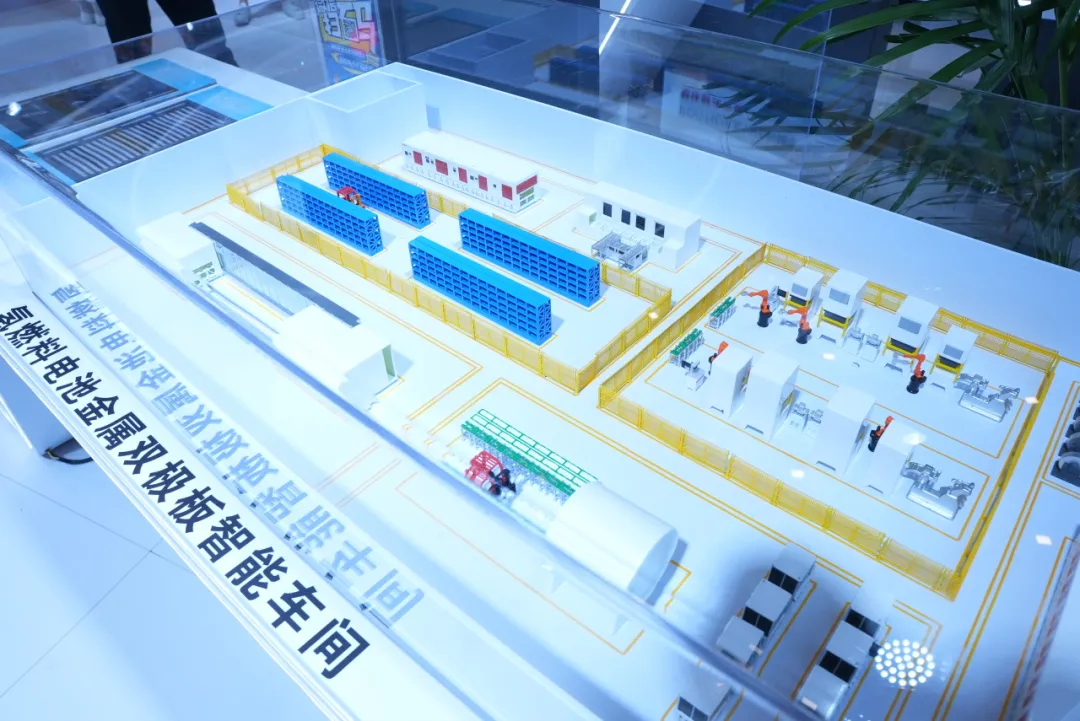
Three Iterations in Three Years: Yield Improved by 1.5%
Since the launch of its hydrogen energy metal bipolar plate welding equipment in 2021, Huagong Tech has completed three rounds of optimization in just three years, resulting in a 1.5% improvement in yield and breakthrough orders. The sealing quality of the bipolar plates plays a vital role in the performance and lifespan of fuel cell stacks. By applying laser welding technology, Huagong Tech has significantly improved weld quality and efficiency, ensuring higher reliability and stability of fuel cell products.
Turning Points into Gold: High Efficiency, Energy Saving, Cost Reduction
Focusing on SLM (Selective Laser Melting) technology, Huagong Tech has independently developed the LSP series of intelligent metal 3D printing equipment. With a bidirectional blade-based powder spreading system and multi-laser overlap control, the system achieves high forming efficiency while reducing mold costs and material waste. From micro-precision parts to various material structures, the fine beam and high controllability of lasers allow printing of intricate and complex geometries. In automotive manufacturing, for example, rapid integrated forming of complex parts greatly reduces the number of components required, supporting further lightweighting of vehicles.
High-Speed Optical Modules in the Spotlight
Earlier at the Optical Fiber Communication Conference and Exhibition (OFC) in the United States, HG Genuine Optoelectronics unveiled its 1.6T high-speed silicon photonic module powered by self-developed silicon photonic chips, attracting broad industry attention. This product integrates self-developed 200G single-wavelength silicon photonic chips and is compatible with thin-film lithium niobate modulators and quantum dot lasers. Featuring 8 parallel transmit and receive channels, it is expected to reduce power consumption by 40% compared to conventional 1.6T modules.